

- September 22, 2026
- Steve Williams
- 3:56 am
The County Fair Was Breaking Attendance Records, Vandals Hit Lexington Senior High, Winn-Dixie Was Advertising Chuck Roast For 89 Cents A Pound, Reagan Was Confronting The Soviets At The United Nations, And A Strange Little Alien Named ALF Was About To Make His Television Debut
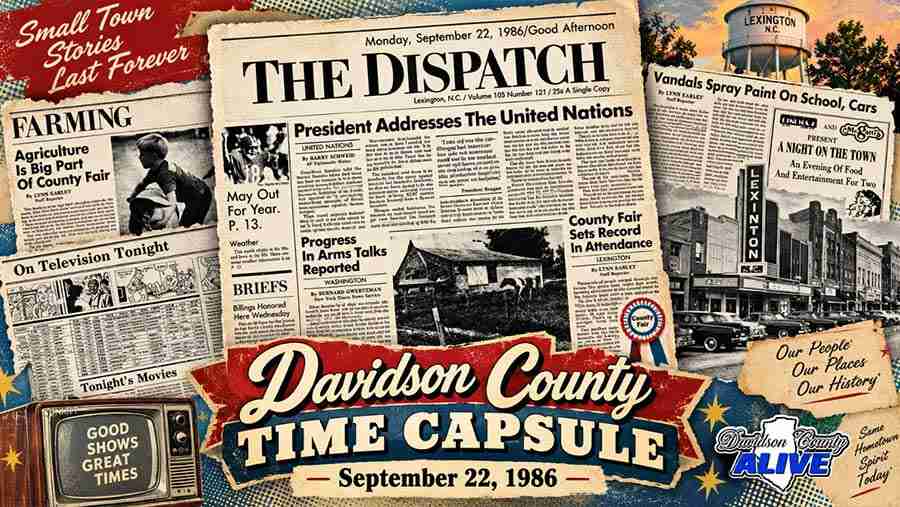
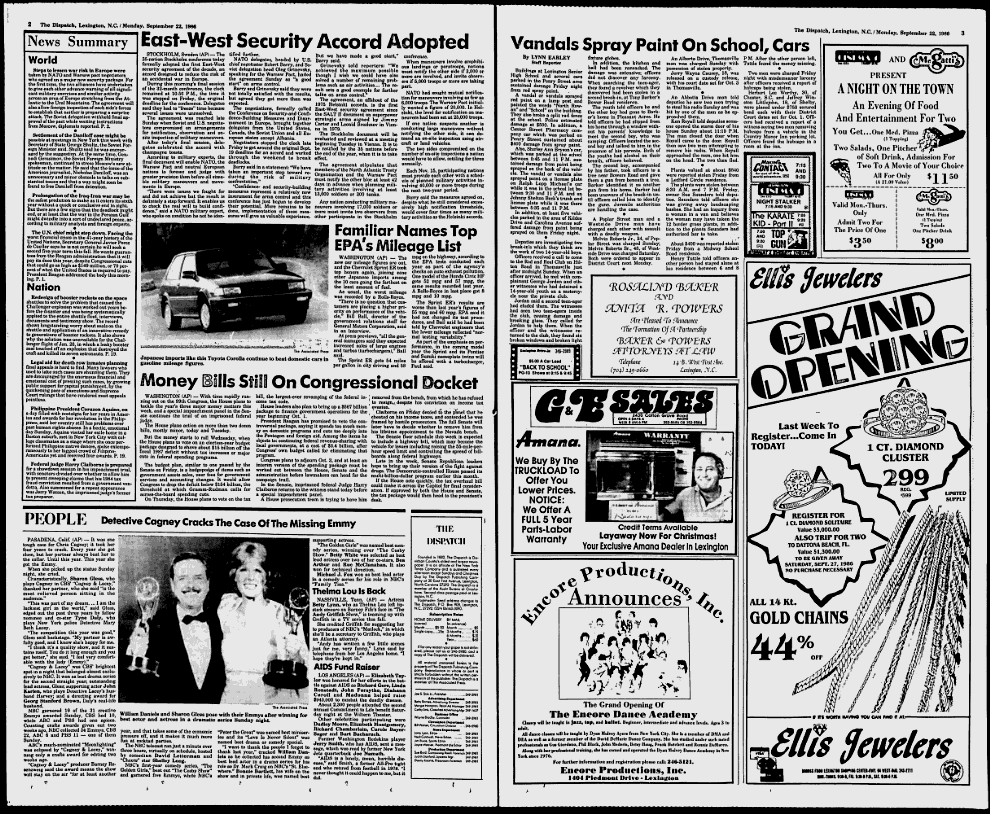
Forty years ago today, Monday, September 22, 1986, a single copy of The Dispatch cost 25 cents.
And now that we have the complete newspaper from that day in front of us, we can do something better than simply look at the big national headlines.
We can spend a day in Davidson County.
The Davidson County Fair had just wrapped up with record attendance. Agriculture was still important enough to local life to command an entire newspaper page. Someone had spray-painted Lexington Senior High School and cars parked nearby. Local jewelers, appliance stores, furniture dealers, restaurants and car lots packed the paper with advertisements.
The sports pages were buzzing about a wild NFL shootout. North Carolina was arguing about Cape Hatteras Lighthouse, the death penalty and radioactive waste. President Ronald Reagan was addressing the United Nations while the United States and Soviet Union cautiously explored nuclear arms reductions.
And when people got home that evening, they could turn on the television and watch something brand new called ALF.
This is Davidson County and the world as readers of The Dispatch saw it on September 22, 1986.




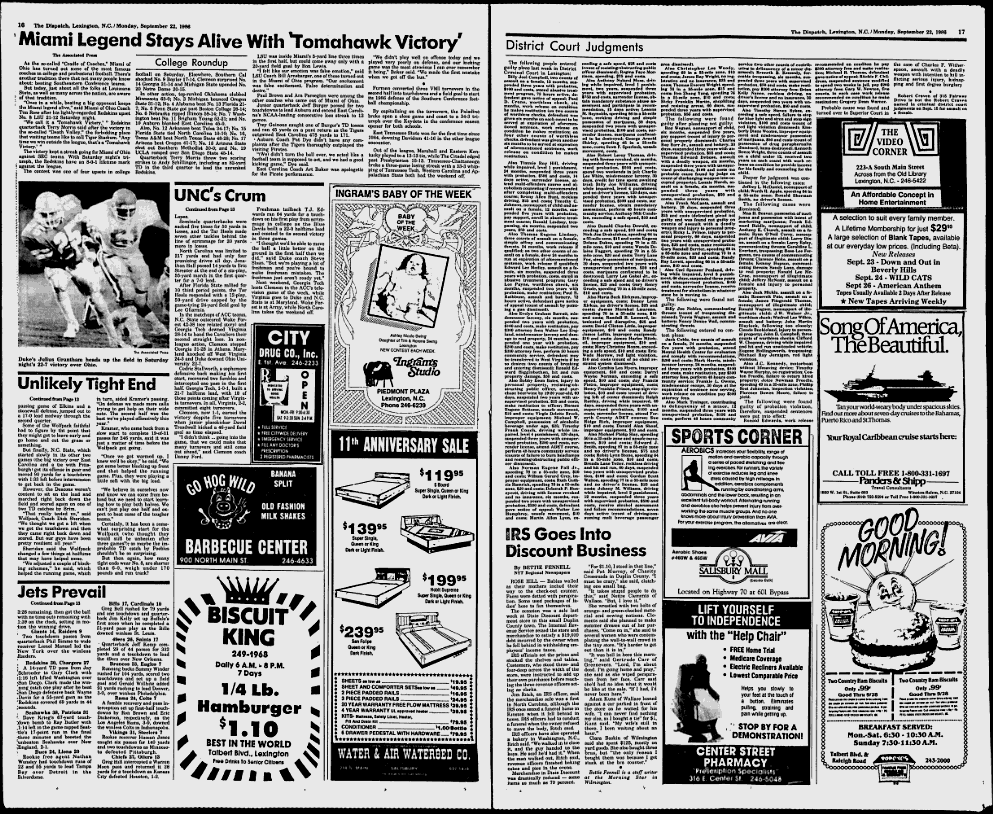


THE BIG LOCAL STORY: THE DAVIDSON COUNTY FAIR HAD A RECORD YEAR
The biggest Davidson County story on the front page wasn’t crime, politics or development.
It was the County Fair.
Under the headline “County Fair Sets Record In Attendance,” Dispatch staff reporter Lynn Earley reported that thousands of people had passed through the gates during the six-day event and that organizers considered it the most successful fair to that point.
The fair wasn’t treated merely as entertainment.
Page 11 carried an entire Farming section beneath the headline:
“Agriculture Is Big Part Of County Fair.”
That says a great deal about Davidson County in 1986.
Livestock, crops, farm exhibits, youth competitions and agricultural education remained a visible part of the county’s identity. The accompanying photograph showed a young exhibitor with livestock, an image that would have been instantly familiar to farm families throughout Davidson County.
The newspaper’s coverage also reminds us that the fair served a purpose beyond rides and midway games. It was a place where the county’s agricultural community showed what it produced and where younger generations learned the traditions surrounding farming and livestock.
On the front page, The Dispatch paired its fair coverage with a photograph simply titled “Summer’s End.”
Flowers were still blooming and a horse stood near Highway 150 in the Arcadia area as summer officially wound down.
It was an appropriate photograph for September 22.
Fall was arriving in Davidson County.
VANDALS HIT LEXINGTON SENIOR HIGH AND CARS NEARBY
Turn to Page 3 and the leading local story became considerably less cheerful:
“Vandals Spray Paint On School, Cars.”
According to The Dispatch, buildings at Lexington Senior High School and several automobiles were damaged during a Friday-night vandalism spree.
Spray-painted messages appeared around the school property, and vehicles in the area were also targeted.
It’s the sort of local story that probably generated plenty of conversation around Lexington on Monday morning.
It also demonstrates how different local news could feel in 1986.
There was no Facebook group where somebody immediately posted photographs.
No neighborhood app.
No police department social-media feed pushing instant updates to everyone’s phone.
For many residents, The Dispatch was where they learned about it.
DAVIDSON COUNTY WAS STILL FARM COUNTRY
Agriculture shows up repeatedly throughout the issue.
In addition to the County Fair coverage, the Farming page carried livestock prices, farm briefs, agricultural events and advertisements directed specifically at farmers.
One advertisement offered Belarus 800 tractors.
Another promoted chimney service.
A local farmer’s market advertised two hot dogs for 99 cents.
Elsewhere, tobacco remained visible in the broader North Carolina agricultural story. An article titled “Planters Warehouse: The Sole Survivor” looked at the fading world of tobacco auction warehouses.
That provides a snapshot of North Carolina in transition.
Tobacco, textiles, agriculture and furniture manufacturing were still deeply connected to the state’s economy and culture in 1986, even though enormous changes would arrive over the following decades.
A TRIP TO THE GROCERY STORE REALLY DOES FEEL LIKE A TIME MACHINE
Perhaps nothing in the newspaper makes 1986 feel farther away than the grocery advertisements.
A full-page Winn-Dixie ad offered boneless chuck roast for 89 cents a pound.
Bone-in shoulder roast was $1.49 a pound.
Boneless lean stew beef was $1.89 a pound.
Tokay grapes were 59 cents a pound.
A three-pound bag of yellow onions was 89 cents.
A 32-ounce jar of mayonnaise was advertised for 68 cents, a 42-ounce box of detergent for 99 cents, and three one-pound packages of margarine for $1.
Across town, Lowe’s Food and Thrifty Mart advertised boneless beef chuck roast for $1.18 a pound, ground beef patties for 99 cents a pound, chicken thighs or drumsticks for 79 cents a pound, and paper towels for 39 cents a roll.
Of course, wages were also considerably lower in 1986, so comparing sticker prices alone doesn’t tell the whole economic story.
Still, seeing 89-cent-a-pound chuck roast in a 2026 grocery world has a way of getting your attention.
LEXINGTON BUSINESSES FILLED THE PAPER
The advertisements themselves form a surprisingly useful historical record.
Ellis Jewelers was promoting a grand opening with a one-carat diamond cluster priced at $299.
C&J Sales advertised Amana appliances and televisions, even offering Christmas layaway.
Encore Productions announced the grand opening of The Encore Dance Academy on Piedmont Drive.
There were advertisements for local attorneys, furniture stores, restaurants, appliance dealers, travel agencies, insurance companies and automotive businesses.
The classified section stretched across multiple pages.
There were homes.
Apartments.
Jobs.
Used automobiles.
Merchandise.
Services.
Before Craigslist, Facebook Marketplace, Zillow, Indeed and AutoTrader on your phone, those pages were where a large part of the local economy met.
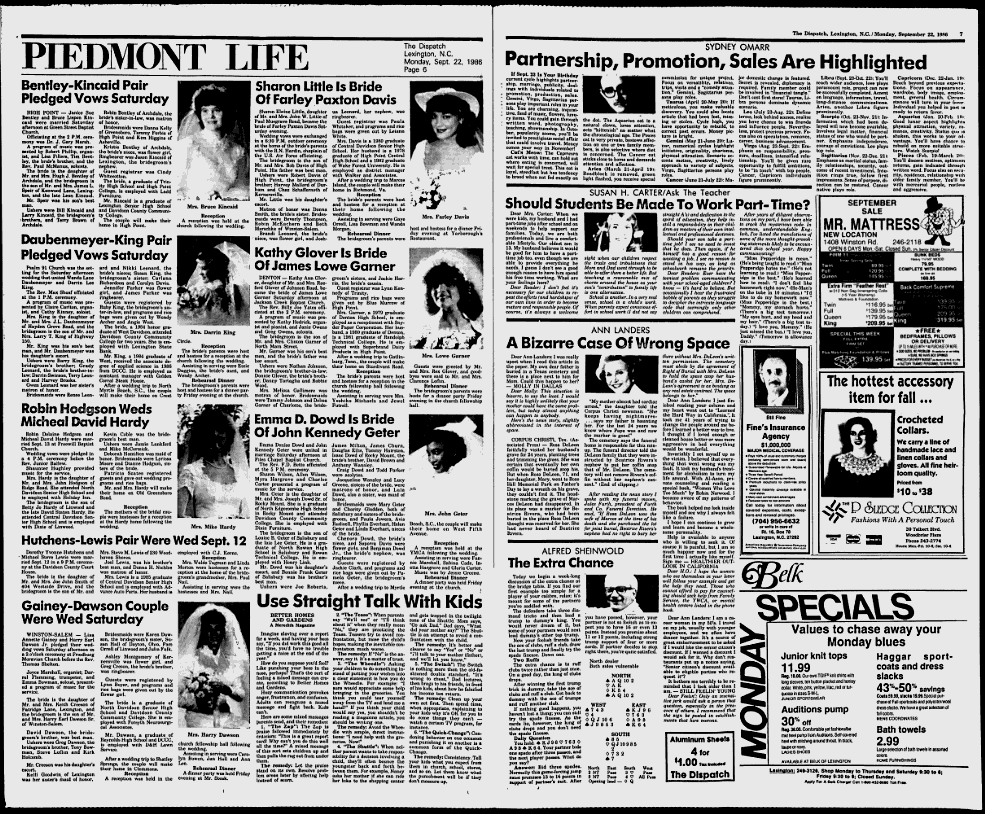
THE “PIEDMONT LIFE” PAGE WAS THE SOCIAL MEDIA OF ITS DAY
Page 6 may be one of the most charming parts of the entire issue.
Under the banner PIEDMONT LIFE, The Dispatch published wedding and engagement photographs along with lengthy accounts of local ceremonies.
There were brides, bridesmaids, parents, churches, receptions and honeymoon details.
People clipped those stories out and saved them.
Births, marriages, anniversaries and deaths passed through the newspaper as part of the community’s collective record.
In a very real sense, pages like Piedmont Life performed one of the jobs now handled by Facebook and Instagram.
Except nobody had to wonder whether an algorithm was going to let Aunt Betty see the wedding pictures.
NORTH CAROLINA WAS DEBATING THE FUTURE OF CAPE HATTERAS LIGHTHOUSE
The state-news page featured a major story headlined:
“Debate Swirls Around Hatteras Lighthouse.”
The problem was erosion.
The famous lighthouse stood increasingly vulnerable to the Atlantic Ocean, and North Carolinians were debating whether it should remain where it was, receive additional protection or eventually be moved.
A reader in Davidson County in September 1986 did not know how that story would end.
We do.
Thirteen years later, in 1999, the Cape Hatteras Lighthouse was moved 2,900 feet to a new location because of the threat posed by shoreline erosion. The actual move took 23 days, beginning June 17 and ending July 9.
But on September 22, 1986, that was still the future.
Readers were watching the argument unfold.
THE DEATH PENALTY, TEACHERS AND RADIOACTIVE WASTE WERE STATE NEWS
Other North Carolina headlines reveal some of the major policy debates of the period.
“Death Penalty Remains Key Issue” examined the continuing legal and political debate surrounding capital punishment.
Another story warned:
“State Challenged With Opening Dump By 1992.”
North Carolina was facing federal deadlines and regional responsibilities surrounding low-level radioactive waste. A North Carolina legislative report from the period documented a series of federal target dates leading into the early 1990s, including a January 1992 deadline for filing an application for a low-level radioactive-waste disposal facility. North Carolina was later selected as the host state for the Southeast regional facility.
Another headline reported on an experiment to give teachers more latitude, part of a broader discussion about whether educators and individual schools should have more control over classroom decisions.
State lawmakers were also studying ways to simplify occupational and professional licensing.
Different decade, different details.
But education policy, government regulation, waste disposal and the death penalty would hardly sound like unfamiliar subjects to a North Carolina reader today.
THE COLD WAR DOMINATED THE FRONT PAGE
The largest headline in the September 22 edition was:
“President Addresses The United Nations.”
President Ronald Reagan traveled to New York that morning to address the 41st Session of the United Nations General Assembly.
American journalist Nicholas Daniloff, the Moscow correspondent for U.S. News & World Report, had been arrested by Soviet authorities and accused of espionage.
The Reagan administration rejected the accusation.
Reagan told the General Assembly:
“Nicholas Daniloff is an innocent hostage who should be released.”
That wording comes directly from Reagan’s September 22 address.
At the same time, Reagan was talking about something potentially much larger than the fate of one journalist.
Nuclear weapons.
Reagan said the United States and Soviet Union had agreed at their previous Geneva summit to continue pursuing reductions in nuclear arms. He told the General Assembly that subsequent Soviet proposals appeared to represent a serious effort, even though the United States did not accept them as proposed.
He said there had been “movement” in the negotiations and continued to call for major reductions in offensive nuclear arsenals.
That combination captured the strange state of the Cold War in late 1986.
Washington and Moscow were confronting one another publicly while simultaneously trying to determine whether meaningful nuclear arms reductions were possible.
EAST AND WEST HAD JUST AGREED ON SOMETHING
Page 2 carried another major headline:
“East-West Security Accord Adopted.”
This one was significant.
On September 22, the United States and 34 other governments adopted an agreement resulting from the Stockholm Conference on Confidence- and Security-Building Measures and Disarmament in Europe.
The agreement required participating countries to notify one another of certain major military activities, invite observers, forecast exercises and permit inspections intended to verify compliance.
According to Reagan’s statement that day, it was the first East-West agreement in which the Soviet Union agreed to inspection of military activities on Soviet territory.
The purpose was straightforward.
If each side had more information about what the other side’s military was doing, there was less chance that a large exercise or troop movement would be mistaken for preparations for war.
Nobody reading The Dispatch that Monday yet knew where the U.S.-Soviet relationship was headed.
Reagan and Gorbachev were only weeks away from their dramatic October meeting in Reykjavik, Iceland.
The Cold War wasn’t over.
But something was changing.
PAT ROBERTSON WAS TESTING A PRESIDENTIAL RUN
Politics also appeared prominently on the front page beneath the headline:
“Christian Right Wing Seeks Political Unity.”
Another article inside the newspaper was titled:
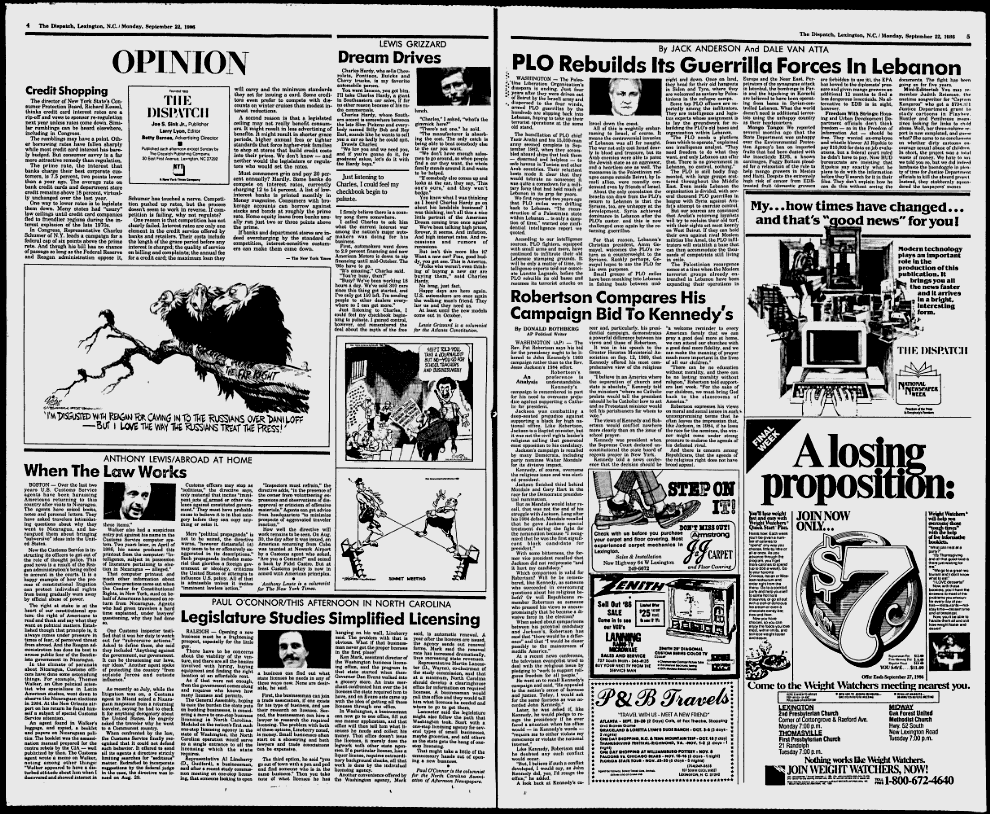
“Robertson Compares His Campaign Bid To Kennedy’s.”
Television evangelist Pat Robertson was considering a campaign for the 1988 Republican presidential nomination.
Robertson had announced that if at least three million registered voters signed petitions committing to “pray, to work, and to give” toward a campaign effort, he would seek the Republican nomination.
The Dispatch story also discussed Robertson’s comparison between questions surrounding his religious background and the religious issue John F. Kennedy confronted as a Catholic candidate in 1960.
Robertson’s possible candidacy was part of a broader effort among politically active evangelical Christians to increase their influence within Republican politics.
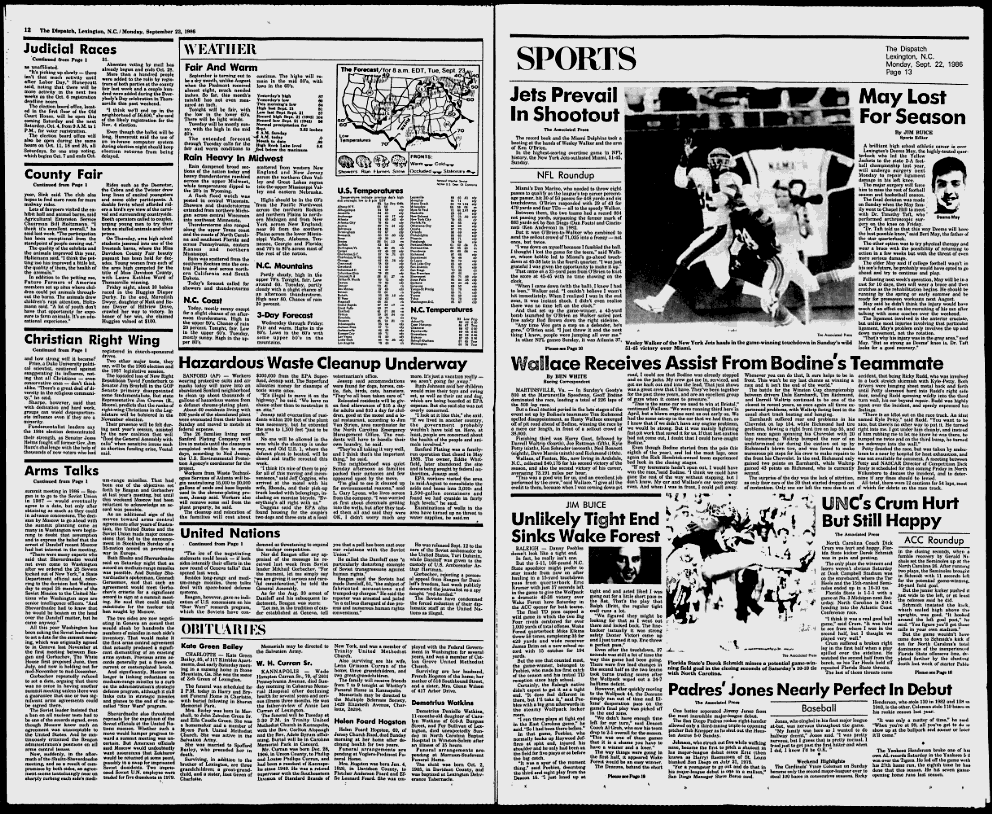
The front page also carried “Judicial Races Crowd Election Ballot,” another reminder that North Carolina’s November elections were approaching.
PARIS WAS LIVING UNDER THE THREAT OF BOMBS
World news became grim on Page 9.
A large article was headlined:
“An American In Paris Finds A City Under Threat.”
Paris had been struck by a series of terrorist bombings, producing fear and increased security across the French capital.
Elsewhere in the newspaper, readers encountered stories involving Lebanon, the Palestine Liberation Organization and continuing instability across the Middle East.
The international section of a local newspaper in 1986 could feel extraordinarily serious.
Cold War confrontation in Europe.
Terrorism in Paris.
Conflict in Lebanon.
Nuclear arms.
Those stories arrived in Davidson County folded together with grocery advertisements, wedding announcements and the county fair.
THE SPORTS PAGE HAD A WILD NFL SHOOTOUT
Football fans had plenty to talk about.
The major sports headline was:
“Jets Prevail In Shootout.”
And “shootout” was certainly accurate.
The previous day, the New York Jets defeated the Miami Dolphins 51-45 in overtime.
Miami quarterback Dan Marino threw for 448 yards and six touchdowns.
Jets quarterback Ken O’Brien threw for 479 yards.
Wesley Walker caught four touchdown passes from O’Brien, including the 43-yard touchdown in overtime that ended the game.
Ninety-six combined points.
Six Marino touchdown passes.
Nearly 1,000 combined passing yards between the quarterbacks.
That gives you some idea why the game was filling sports pages Monday morning.
RUSTY WALLACE HAD JUST WON AT MARTINSVILLE
NASCAR also occupied prime real estate in the sports section.
Rusty Wallace had won Sunday’s Goody’s 500 at Martinsville Speedway, driving the No. 27 Pontiac.
Geoffrey Bodine won the pole, while Wallace led 171 of the race’s 500 laps on his way to victory.
The Dispatch headline focused on some of the strategy surrounding Wallace’s win:
“Wallace Receives Assist From Bodine’s Teammate.”
For a Davidson County readership in the heart of stock-car country, Martinsville wasn’t some distant national sporting event.
It was regional conversation.
N.C. STATE AND WAKE FOREST HAD A SHOOTOUT OF THEIR OWN
The college football pages weren’t quiet either.
N.C. State had beaten Wake Forest 42-38 on Saturday.
North Carolina had played Florida State to a 10-10 tie.
Yes, a tie.
That’s an especially nice little time capsule from the sports page.
The NCAA Football Rules Committee had approved a limited overtime tiebreaker system in 1981, but it wasn’t yet mandatory for all tied games. That would not happen until 1996, when the NCAA adopted overtime for games still tied after regulation.
So in 1986, North Carolina and Florida State could play four quarters, finish 10-10, and everybody simply went home.
THE EMMYS HAD BEEN THE NIGHT BEFORE
The entertainment pages carried fresh coverage of the 38th Primetime Emmy Awards, held Sunday night, September 21.
The Golden Girls won Outstanding Comedy Series.
Betty White won Outstanding Actress in a Comedy Series.
Michael J. Fox won Outstanding Actor in a Comedy Series.
And legendary comedian Red Skelton received the Governors Award.
The Dispatch headline captured Skelton’s appearance:
“Skelton Honored At Emmys, Recalls Pain Of Cancellation.”
Skelton had been away from regular television for 16 years, something he mentioned during his acceptance speech.
Then Monday night arrived.
And television history quietly happened again.
sports headline was:
“Jets Prevail In Shootout.”
And “shootout” was certainly accurate.
The previous day, the New York Jets defeated the Miami Dolphins 51-45 in overtime.
Miami quarterback Dan Marino threw for 448 yards and six touchdowns.
Jets quarterback Ken O’Brien threw for 479 yards.
Wesley Walker caught four touchdown passes from O’Brien, including the 43-yard touchdown in overtime that ended the game.
Ninety-six combined points.
Six Marino touchdown passes.
Nearly 1,000 combined passing yards between the quarterbacks.
That gives you some idea why the game was filling sports pages Monday morning.
WHAT WAS ON TV THAT NIGHT?
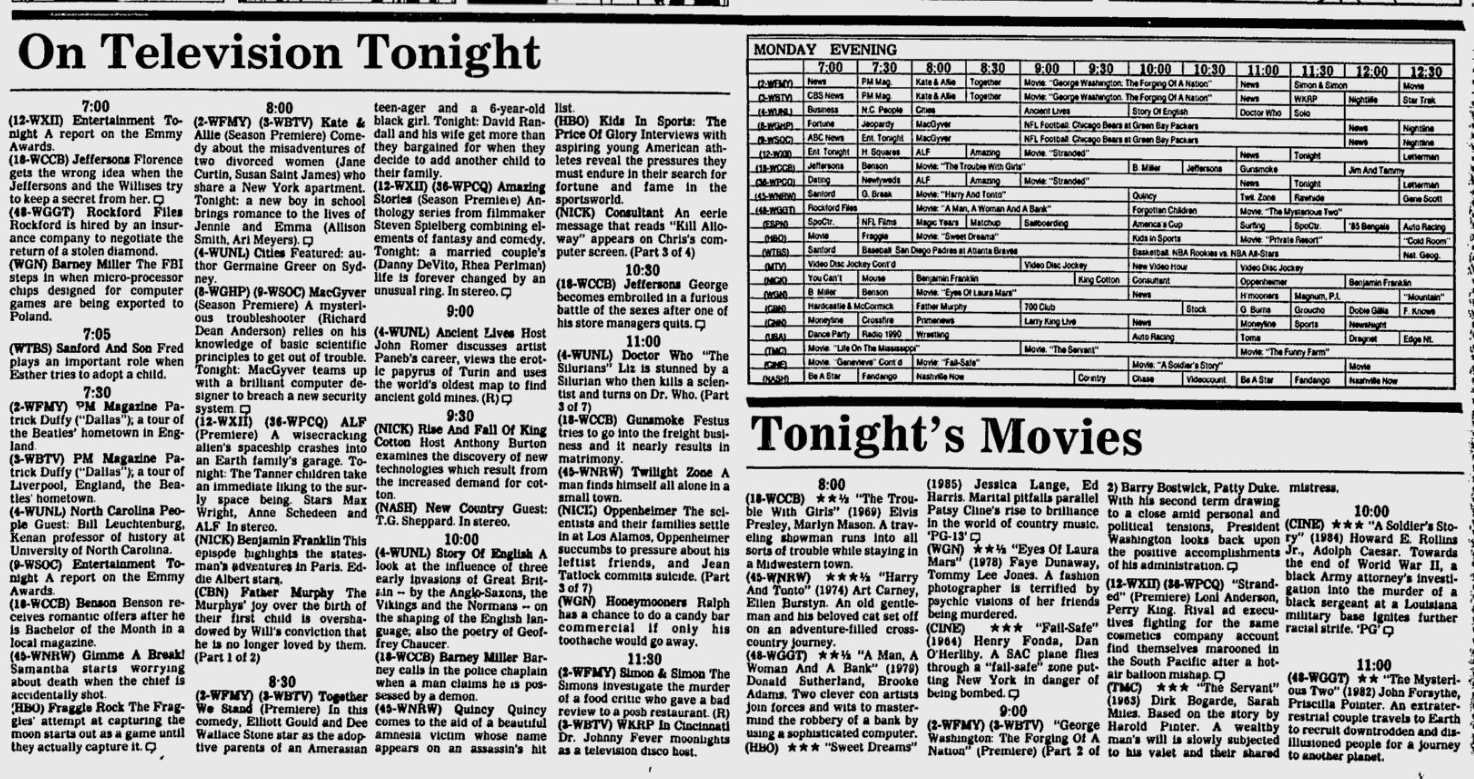
This may still be my favorite part of the entire newspaper.
After reading about Reagan, the Soviet Union, the county fair, school vandalism, football scores and 89-cent chuck roast, Davidson County families could turn to the television listings and decide what to watch.
And Monday, September 22, 1986 was the premiere night of ALF.
At 8 p.m. on NBC, viewers met Gordon Shumway, the furry, wisecracking alien from the planet Melmac, for the first time.
The Paley Center’s television archive confirms that ALF premiered on NBC at 8 p.m. on September 22, 1986.
The competition wasn’t exactly weak.
ABC had MacGyver.
CBS offered Kate & Allie, followed at 8:30 by the premiere of Together We Stand.
NBC followed ALF with Steven Spielberg’s Amazing Stories.
At 9 p.m., CBS aired George Washington: The Forging of a Nation, Part 2.
NBC showed the television movie Stranded.
And ABC had what may have been the obvious choice in plenty of Davidson County households:
Monday Night Football.
The defending Super Bowl champion Chicago Bears were playing the Green Bay Packers at Lambeau Field.
Chicago won 25-12.
And if you were still awake later that evening, there was Johnny Carson and the familiar world of late-night television.
Think about that lineup for a moment.
MacGyver.
The first-ever episode of ALF.
Amazing Stories.
Johnny Carson.
Monday Night Football at Lambeau.
No streaming.
No DVR.
No on-demand library containing every episode whenever you felt like watching it.
Unless you had a VCR programmed to record one of them, you picked one.
And everybody watching ALF that night was watching something nobody yet knew would become a piece of 1980s pop-culture nostalgia.
It wasn’t nostalgia.
It was just the new show on NBC.
AND THAT MAY BE THE BEST PART OF LOOKING THROUGH AN OLD NEWSPAPER
The biggest surprise in this entire September 22, 1986 edition isn’t any single headline.
It’s how completely a newspaper preserved a day.
The front page tells you what people were supposed to worry about.
The local pages tell you what happened down the street.
The farming page tells you how people made a living.
The wedding announcements tell you who was starting families.
The sports section tells you what people were probably arguing about at work Monday morning.
The advertisements tell you what things cost and where people shopped.
The classifieds tell you what people were selling, buying and looking for.
And the television page tells you what everybody might have been doing after supper.
For someone living in Davidson County on September 22, 1986, Ronald Reagan and Mikhail Gorbachev were not historical figures yet.
The Cold War wasn’t a chapter in a textbook.
Cape Hatteras Lighthouse had not been moved.
ALF wasn’t nostalgia.
Johnny Carson was still on television.
The Davidson County Fair was breaking attendance records.
Winn-Dixie really was advertising chuck roast for 89 cents a pound.
And tomorrow’s newspaper hadn’t happened yet.
That’s what makes these old editions of The Dispatch so much fun.
For a few pages, 1986 isn’t history anymore.

Steve is an entrepreneur, freelance writer, and super-geek tech nerd based in Lexington, NC. Steve specializes in social media platform development, website design, graphic design, and video production…and serving the one true creator of the universe, aka God.
REFERENCES AND SOURCES
The Dispatch, Lexington, North Carolina, Monday, September 22, 1986. Google News Newspaper Archive and the archived edition reproduced for this article.
Ronald Reagan Presidential Library, “Address to the 41st Session of the United Nations General Assembly in New York, New York,” September 22, 1986. Read the address
Ronald Reagan Presidential Library, “Statement on the Conference on Confidence and Security Building Measures and Disarmament in Europe,” September 22, 1986. Read the statement
National Park Service, “Moving the Cape Hatteras Lighthouse.” Cape Hatteras Lighthouse history
North Carolina General Assembly, “Low-Level Radioactive Waste Regulation: Report to the 1987 General Assembly.” Read the legislative report
The Washington Post, “‘To Pray, to Work, and to Give,’” September 1986. Read the contemporary report
Television Academy, “76 Years of Emmy.” View the Television Academy history
Paley Center for Media, “ALF: A.L.F. {Series Premiere}.” View the archive entry
Pro Football Reference, Miami Dolphins at New York Jets, September 21, 1986; Chicago Bears at Green Bay Packers, September 22, 1986. Jets-Dolphins box score Bears-Packers box score
NASCAR Reference, 1986 Goody’s 500 at Martinsville Speedway. View race results
Comment On Facebook