


- September 19, 2026
- Steve Williams
- 10:58 pm
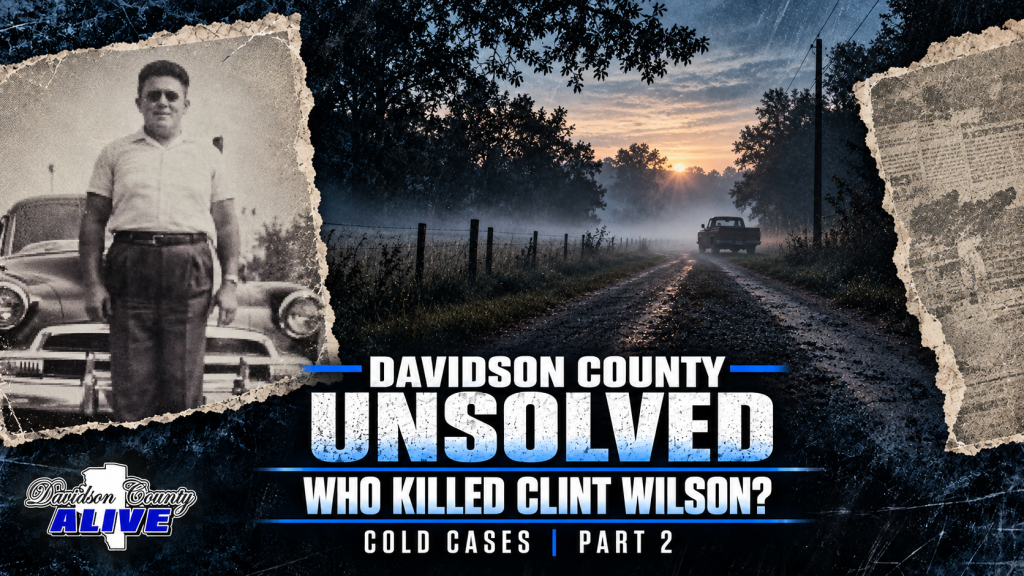
Clint and James Wilson left for work before dawn on May 26, 1975. Less than two hours later, Clint was dead and James was unconscious inside their pickup. A missing wallet reportedly containing more than $7,000 and an unexplained cable found in Clint’s hand became pieces of a case that remains unsolved more than 51 years later.
A ROUTINE TRIP TO WORK
Clint Herman Wilson and his older brother, James Spurgeon Wilson, left their home at about 5:30 on the morning of Monday, May 26, 1975. According to a contemporary clipping from The Dispatch in Lexington, both men were headed to their jobs at Thomasville Furniture Industries.
The trip should have been routine. By approximately 7:20 a.m., the Davidson County Sheriff’s Department had received a report that brought deputies to a rural road between Lexington and Thomasville.
Clint, 59, was found lying face down in the roadway. James, 65, was unconscious inside the pickup. Both men had suffered severe blows. Clint was dead at the scene.
The early newspaper report described the attack as an apparent robbery. The Davidson County Sheriff’s Office would later emphasize a fact that has followed the case for more than half a century: Clint reportedly had more than $7,000 in his wallet, and the wallet was never recovered.
No one has been publicly identified as the person responsible.
TWO ACCOUNTS OF THE LOCATION
The newly supplied Dispatch clipping adds important detail, but it also reveals a location discrepancy that cannot be resolved from the public sources alone.
The newspaper said the attack occurred on “Jessie Green Road” between Lexington and Thomasville, using that spelling in the printed account. Sheriff Jaybird McCrary reportedly said the brothers were found about a quarter mile from their home and that Clint’s body was approximately 30 feet from the pickup.
The Davidson County Sheriff’s Office’s current cold-case summary gives a different location. It says Mrs. Van Conrad Jr. called to report what appeared to be two bodies in the roadway on Finch Farm Road, off Old 29 near Rich Fork Creek. It describes Clint as being on a dirt road leading from his residence to the main highway. A June 11, 1975, follow-up in The High Point Enterprise also placed the brothers in or near their pickup on Finch Farm Road.
It is possible that the accounts referred to a connecting road, a nearby landmark or different descriptions of the same general area. It is also possible that one account contained an error. The available sources do not provide a scene map or exact address that would allow DC Alive to reconcile the difference.
For that reason, this article does not present either road name as conclusively established. What the sources agree on is that the brothers were attacked close to home along a rural roadway in Davidson County.
WHAT DEPUTIES FOUND
The Dispatch clipping provides the most detailed surviving public description of the scene reviewed for this article.
Deputies reportedly found Clint face down in the road with injuries to his head and upper torso. The newspaper said he had a large wound on the back of his head and was clutching what authorities described as either a car-battery jumper cable or an electrical cable in his right hand.
The significance of that cable is not explained. The public record does not say whether investigators believed it belonged to Clint, came from the pickup, had been used during the attack or was unrelated to the assault. It should not be described as the murder weapon without supporting evidence.
James was found unconscious in the pickup with similar injuries. He was initially transported by ambulance to Community General Hospital and then transferred to High Point Memorial Hospital, where the early report listed him in stable condition.
The clipping said James had not remained conscious long enough to give officers an account of what happened. A June 11 follow-up reported that he had been treated in intensive care and was released from the hospital on Monday, June 9.
Those two reports confirm that James survived an extremely serious attack. They do not disclose what he remembered after his condition improved or whether he was eventually able to identify the attacker.
WHO CLINT WILSON WAS
The newspaper clipping also restores something largely absent from the sheriff’s brief online summary: a picture of Clint’s life before his name became associated with an unsolved homicide.
Clint was born in Macon County to Johnny and Martha Passmore Wilson. He had lived in Thomasville for 24 years and worked in a warehouse for Thomasville Furniture Industries. He was a World War II veteran and a member of Fairview Baptist Church in Nantahala.
In 1946, he married Janie Passmore. The newspaper’s survivor list identified his wife, two daughters, three sons, three brothers, two sisters and a grandchild. James, the brother who survived the attack, was included among those family members.
Clint’s funeral was scheduled at Union Hill Baptist Church in Macon County, with burial in the church cemetery.
These details do not solve the crime, but they prevent the case from being reduced to a wallet and an amount of money. Clint was a husband, father, grandfather, brother, veteran and furniture-industry employee. James was not simply a surviving witness. He was Clint’s brother, coworker and fellow victim.
AN APPARENT ROBBERY, BUT NO PROVEN MOTIVE
The early Dispatch story characterized the assault as an apparent robbery. That description is understandable in light of the missing wallet, but the surviving public record does not establish robbery as the proven motive.
The sheriff’s current case summary says investigators determined that Clint had more than $7,000 in his wallet at the time of his death and that the wallet remains missing. The page does not explain why he was carrying so much money, how investigators confirmed the amount, who knew about it or whether any of the cash was later recovered separately.
It also does not say whether anything was taken from James, the pickup or the brothers’ home.
The responsible conclusion is therefore limited: Clint reportedly possessed more than $7,000; the wallet containing it was missing; and robbery was considered an apparent explanation in the earliest newspaper account. Those facts make robbery a serious possibility, but they do not prove why the brothers were attacked.
THE MAY 16 DATE APPEARS TO BE AN ERROR
The additional clipping helps resolve a discrepancy on the sheriff’s current Wilson page.
The official page says the call reporting the brothers was received May 26, 1975. The sheriff’s cold-case index also dates the homicide and assault to May 26. The Dispatch described the men as being found on a Monday morning, and May 26, 1975, was a Monday. It further reported that they had left for work around 5:30 that morning.
In one sentence, however, the sheriff’s individual case page says Clint and James left for work on May 16. That date was a Friday and does not fit the contemporary account of the brothers being discovered Monday morning. The June 11 High Point Enterprise report also says they were found May 26.
With the official incident date and both contemporary newspaper reports supporting May 26, the May 16 reference on the current case page appears to be a typographical error. The original incident report would remain the definitive source, but the new clipping makes the correction substantially better supported than it was before.
THE FIRST DAYS OF THE INVESTIGATION
Sheriff McCrary told The Dispatch that investigators had no suspects at the time of the initial report. Clint’s body was sent to Chapel Hill for an autopsy.
The clipping does not provide the autopsy findings beyond its early description of blows to Clint’s head and upper torso. It does not identify the type of blunt instrument used, indicate whether a weapon was recovered or say whether investigators believed one or more attackers were involved.
On June 11, a little more than two weeks after the homicide, The High Point Enterprise reported that the investigation remained active but had produced no major new developments. The update attributed that information to sheriff’s department spokesman Billy R. Nail and noted James’s release from the hospital.
DC Alive found no publicly available record showing that anyone was arrested or charged in connection with the attack. Today, the Davidson County Sheriff’s Office lists the Wilson case as an unsolved homicide and assault dated May 26, 1975.
WHAT JAMES MAY HAVE KNOWN
James’s survival makes this case unusual, but it does not mean that investigators necessarily had an eyewitness capable of identifying the attacker.
The initial newspaper account said James had remained unconscious and had not been able to provide a meaningful account by the night following the attack. The public sources reviewed for this article do not say when he was later interviewed, what he remembered or whether his injuries affected his memory.
No public statement from James was located. That does not mean he never provided one. It means any statement preserved in the investigative file has not been made public in the sources examined here.
There are legitimate reasons for withholding a survivor’s account in an open homicide investigation. It may contain details known only to the attacker, describe leads that could not be proved or preserve information investigators could use to evaluate a confession. Without the original interviews, no one outside the investigation should claim to know what James did or did not tell deputies.
QUESTIONS THE PUBLIC RECORD STILL CANNOT ANSWER
The combined newspaper and law-enforcement sources provide a clearer timeline, but major questions remain:
Why do the early Dispatch report and the later public accounts give different road names?
Who knew the brothers’ work schedule and that Clint was carrying a large amount of cash?
Why was Clint holding a jumper cable or electrical cable, and did it have any connection to the attack?
What kind of blunt instrument caused the brothers’ injuries, and was it recovered?
Did evidence indicate that one person or more than one person participated?
What did James remember after regaining consciousness?
Were fingerprints, biological material, tire impressions, footprints or other physical evidence collected and preserved?
Did investigators develop suspects, and if so, what prevented an arrest?
Was any portion of the money ever located independently of the missing wallet?
These are questions, not clues. They should not be used to accuse anyone or turn community rumor into fact. Their value is in showing what could still be clarified by the original investigative file.
A MODERN COLD-CASE REVIEW
The Davidson County Sheriff’s Office’s current Cold Case Team was established in January 2025, according to a September 2026 North Carolina Sheriffs’ Association newsletter. Led by Sergeant Varner, the team includes Sergeant McKnight and Detectives Allen, Hall and Love.
The newsletter says the team is reviewing seven active homicide investigations and four missing-person investigations. Members conduct cold-case work as a collateral duty while continuing their regular assignments. The Wilson homicide and assault are among the cases featured on the sheriff’s website.
A modern review does not guarantee that testable evidence remains from 1975. Evidence preservation, record retention and forensic practices were different then. Still, investigators can reorganize old reports, compare statements, locate people who were never interviewed, revisit timelines and determine whether preserved material can be examined using methods unavailable 51 years ago.
The most useful new information may come from a person rather than a laboratory. Someone may remember who knew about the cash, who was absent from a normal routine, who appeared with unexplained injuries or who suddenly possessed money after the attack. Another person may have heard a firsthand admission but remained silent because of fear or family loyalty.
Those possibilities do not identify a suspect. They explain why an old appeal can still matter.
MEMORY, RUMOR AND RESPONSIBILITY
The new clipping demonstrates why original local reporting is valuable. It preserved names, times, medical information and crime-scene details that do not appear on the sheriff’s current website.
It also demonstrates the need for caution. The road name conflicts with two other sources, and the initial description of an apparent robbery remains a theory rather than a proven motive. Historical reporting should be compared, not simply repeated.
People who lived near Jesse Green Road, Finch Farm Road, Old 29 or Rich Fork Creek in 1975 may remember police activity or conversations surrounding the attack. Former Thomasville Furniture Industries employees may remember the brothers’ routine. Family members may know why Clint had the money.
Firsthand information should be provided to investigators. Publicly accusing someone based on rumor can harm innocent people and distract from evidence. No person has been publicly established as Clint Wilson’s killer in the sources reviewed by DC Alive.
SOMEONE MAY STILL KNOW
On May 26, 1975, Clint and James Wilson left home before dawn for their jobs at Thomasville Furniture Industries. Less than two hours later, Clint was dead in the roadway and James was unconscious in their pickup.
Clint’s wallet was missing. James survived. The questions surrounding the attack survived with him.
Who knew the brothers’ routine? Who knew about the cash? Why was Clint holding a cable? Which road description accurately identifies the scene? Did James eventually remember something that could still be useful?
More than 51 years have passed. Memories have faded, and some witnesses may no longer be alive. Old fears and loyalties may also have changed. A detail that appeared insignificant in 1975 could take on new meaning when compared with the original case file.
Anyone with firsthand information about the killing of Clint Herman Wilson or the assault on James Spurgeon Wilson can submit a tip through the Wilson case page on the Davidson County Sheriff’s Office website.
Clint Wilson deserves more than a line on a cold-case list. James Wilson’s survival deserves more than silence. Their family deserves an answer.

Steve is an entrepreneur, freelance writer, and super-geek tech nerd based in Lexington, NC. Steve specializes in social media platform development, website design, graphic design, and video production…and serving the one true creator of the universe, aka God.
REFERENCES AND SOURCES
- Davidson County Sheriff’s Office, “Wilson.” Official case summary for Clint Herman Wilson and James Spurgeon Wilson, including the Finch Farm Road location, blunt-force attack, missing wallet and tip form.
https://www.davidsoncountysheriffsnc.org/copy-of-morris Davidson County Sheriff’s Office, “Cold Case Investigations.” Official index identifying the Wilson matter as a homicide and assault dated May 26, 1975.
https://www.davidsoncountysheriffsnc.org/coldcaseThe High Point Enterprise, “Work Continues in Wilson Case,” June 11, 1975, page 19. Contemporary report stating that the brothers were found May 26 in or near their pickup on Finch Farm Road, that the investigation remained active and that James had been released from the hospital. Accessed through NewspaperArchive.
https://newspaperarchive.com/high-point-enterprise-jun-11-1975-p-19/North Carolina Sheriffs’ Association, “NC Cold Case | Davidson County Sheriff’s Office’s Cold Case Unit,” September 10, 2026. Summary of the present cold-case team, its membership and active caseload.
https://multibriefs.com/briefs/ncsa/NCSA091026.php
Comment On Facebook