

- September 22, 2026
- Steve Williams
- 1:13 am
From Indigenous Trading Paths And A County Seat That Never Was To Railroads, Furniture Factories, Textile Mills And Lexington Barbecue, More Than Two Centuries Of Davidson County History Are Still Hiding In Plain Sight
Davidson County officially appeared on a North Carolina map in 1822.
Its story began much earlier.
Long before Lexington had a courthouse, Thomasville had a railroad depot or anyone was cooking pork shoulders beside the town square, people were traveling, trading and living along the Yadkin River and across the rolling Piedmont landscape that would eventually become Davidson County.
Some of the oldest transportation routes through the county existed centuries before the first paved highway. Some modern roads still roughly follow them.
The county has been Native homeland, colonial backcountry, farming country, a railroad corridor, a manufacturing powerhouse and the birthplace of traditions that became known far beyond North Carolina.
And one of the strangest facts comes right at the beginning:
The Davidson County we know today was not North Carolina’s first Davidson County.
BEFORE DAVIDSON COUNTY, THERE WAS THE TRADING PATH
The history of Davidson County does not begin with European settlement.
Written historical accounts associate the area of present-day Davidson County with several Native peoples, including the Guatari, Saura and Saponi. Those written records represent only a small portion of a much longer Indigenous presence in the North Carolina Piedmont.
One of the most important places in that early story was Trading Ford, where established Native trails crossed the Yadkin River near what is now southern Davidson County.
The ford was part of a much larger network of trading routes connecting communities across Virginia and the Carolinas. European explorers and settlers later followed many of the same paths.
In 1701, English explorer John Lawson traveled through the area and encountered Saponi people near Trading Ford. Lawson described the surrounding country in glowing terms, writing of a landscape so fertile and attractive that it clearly made an impression on him.
The route did not disappear when European settlement increased.
During the 1700s, the Trading Path and Great Wagon Road became major migration corridors for families moving south from Pennsylvania, Maryland, New Jersey and Virginia. German, Scots-Irish and other settlers entered the Carolina backcountry along these routes and established farms and communities throughout the region.
In other words, Davidson County’s role as a transportation corridor is much older than U.S. 64, U.S. 52 or Interstate 85.
The highways came later.
The route was already here.
EARLY SETTLERS PUT DOWN ROOTS
By the middle of the 18th century, permanent European settlements were becoming established throughout the area.
One of the best known was the Jersey Settlement near the Yadkin River, populated in part by families who had migrated south from New Jersey. Other settlements grew along creeks, wagon roads, farms and churches.
Some of those early religious communities survive in recognizable form today.
Pilgrim Church, northeast of Lexington, traces its beginnings to about 1757 and was originally known as Leonard’s Church.
In a largely rural world, churches were more than places of worship. They could become community centers, meeting places, burial grounds and anchors for settlements that otherwise consisted of widely scattered farms.
The landscape gradually filled with roads, mills, taverns, farms and small communities.
Lexington would eventually become the most important of them.
But even Lexington’s origin story is a little more complicated than the familiar date printed in many local histories.
LEXINGTON: TRADITION SAYS 1775, RECORDS SAY LOOK TO 1790
Local tradition says Lexington was named in honor of the Battle of Lexington, Massachusetts, fought on April 19, 1775 at the opening of the American Revolution.
That tradition is old, but documentary evidence for the developing town becomes much clearer a little later.
National Register research found that the first known reference to the town of Lexington in Rowan County deeds dates to 1790, when landowner Michael Beard divided approximately 30 acres into lots around Main Street and began selling parcels.
By 1800, Lexington had a post office.
The 1810 census counted just 83 residents in town.
So while 1775 remains part of Lexington’s traditional origin story, 1790 gives us something historians like even better:
Paperwork.
SURPRISE: THIS WAS NORTH CAROLINA’S SECOND DAVIDSON COUNTY
Here is a piece of local trivia worth remembering.
When North Carolina created Davidson County in 1822, it was actually creating Davidson County for the second time.
In 1783, when North Carolina’s western territory stretched far beyond today’s state boundary, lawmakers created an earlier Davidson County in land that is now part of Tennessee.
North Carolina ceded that western territory to the federal government in 1790. The area later became part of Tennessee, and North Carolina no longer had a Davidson County.
Then, 32 years later, the name returned.
Both counties were named for General William Lee Davidson, the Revolutionary War officer killed at the Battle of Cowan’s Ford on the Catawba River in 1781.
1822: DAVIDSON COUNTY IS CREATED
By the early 19th century, Rowan County covered a large area.
Residents east of the Yadkin River faced a difficult trip to Salisbury whenever they needed to conduct county business, attend court or deal with public records.
The North Carolina General Assembly eventually agreed that a new county was needed.
On November 29, 1822, lawmakers created present-day Davidson County from part of Rowan County.
A Salisbury newspaper, The Western Carolinian, reported the news shortly afterward.
Its assessment was wonderfully direct:
“Old Rowan is now divided.”
The new county government held its first organizational meeting in Lexington on January 27, 1823.
John Monroe was chosen chairman of the county court, David Mock became clerk and James Wiseman became Davidson County’s first sheriff.
But there was a problem.
Lexington was not necessarily supposed to remain the county seat.
MARION: THE DAVIDSON COUNTY TOWN THAT NEVER WAS
If the original plan had worked, Davidson County government might not be centered in Lexington today.
County leaders initially intended Lexington to serve only as a temporary meeting place.
They wanted a brand-new town near the geographic center of the county.
Its name would be Marion.
Commissioners located land for the proposed town, and county officials purchased about 108 acres from Martin Owens along with an additional parcel from Christian Everhart.
Lots were laid out.
Some were sold.
For a moment, Marion appeared destined to become the center of Davidson County government.
Then Lexington fought back.
County records describe what followed as a series of political maneuvers that reopened the county-seat question. The dispute was eventually settled in Lexington’s favor.
On March 24, 1824, land surrounding the present courthouse square was conveyed so lots could be sold and the proceeds used to build a courthouse and jail.
Marion faded before it ever really became a town.
Buyers were refunded for their lots, and Davidson County later used part of the Marion property for the county home, commonly called the poor house.
It may be one of Davidson County’s best forgotten-place stories.
There was once supposed to be another town at the center of the county.
Lexington won.
Marion disappeared.
LEXINGTON BECOMES THE COUNTY SEAT
The historical record firmly establishes Lexington as Davidson County’s permanent seat of government by 1824.
The first county courthouse was completed there in 1825. It was a two-story building designed by architect William Nichols and stood in the public square.
Lexington’s incorporation came soon afterward.
The North Carolina General Assembly passed “An act to incorporate the town of Lexington, in the county of Davidson” in 1827. National Register documentation likewise dates Lexington’s incorporation to 1827, although some later local histories use 1828.
The distinction probably matters most to historians.
To everyone else, Lexington was clearly becoming a real town.
THE COURTHOUSE THAT BECAME A LANDMARK
By the 1850s, Davidson County had outgrown its first courthouse.
County leaders commissioned a much larger building, completed in 1858 on Lexington’s public square.
The structure featured Corinthian columns, arched windows and elaborate architectural details. One contemporary admirer called it a “Temple of Justice.”
That courthouse is still standing.
Its survival was hardly guaranteed.
In 1865, near the end of the Civil War, the building’s interior burned under what state historians describe as suspicious circumstances. Local residents later blamed occupying Union troops, although the precise cause has never been firmly established.
The exterior walls and columns survived, some records were saved, and the courthouse was eventually repaired.
It continued serving Davidson County until a larger courthouse was completed in 1958.
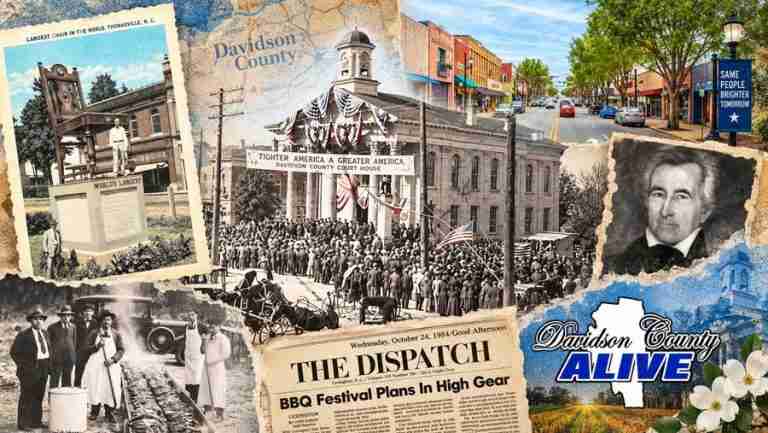
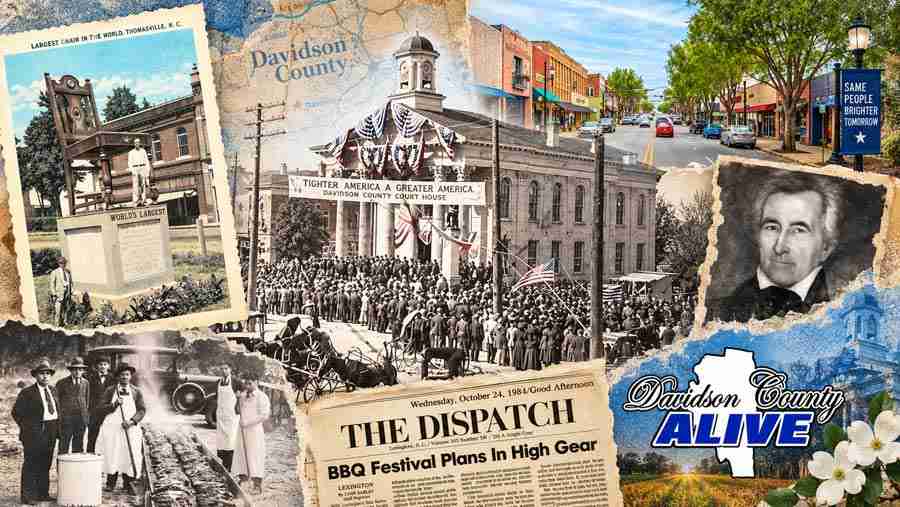
Today the old courthouse is one of the most recognizable buildings in Lexington and is home to the Davidson County Historical Museum.
Few buildings in the county have witnessed more history.
FARMING, SLAVERY AND ANTEBELLUM DAVIDSON COUNTY
Before factories transformed Lexington and Thomasville, Davidson County was overwhelmingly agricultural.
Families produced corn, wheat and other crops, raised livestock and operated mills along local waterways.
Slavery was also part of that economy and cannot be separated from an honest account of the county’s early development.
According to research compiled by the Davidson County Historical Museum, enslaved people made up approximately 20 percent of the county’s population in 1850.
The 1860 census recorded 3,076 enslaved people in Davidson County and 429 slaveholding heads of household.
Most farms did not hold enslaved people. Among those that did, holdings of between one and five people were the most common.
Local records document enslaved people being sold as part of estates, privately transferred as property and hired out for labor. Museum research also documents sales and the rental of enslaved labor at Davidson County’s courthouses.
Those records often reduced human beings to financial entries.
But the people behind those entries helped clear land, grow crops, build structures, perform skilled and domestic labor and raise families here.
Emancipation after the Civil War ended legal slavery, but it did not immediately produce equal political, economic or educational opportunity.
That would become another long chapter in Davidson County history.
THE RAILROAD CREATES A NEW KIND OF COUNTY
The next major transformation arrived on steel rails.
The North Carolina Railroad pushed through the Piedmont during the 1850s, connecting communities to larger markets and changing where businesses could succeed.
Few Davidson County communities were shaped more directly by the railroad than Thomasville.
Businessman and legislator John W. Thomas championed the North Carolina Railroad and helped bring the line through the area where a community developed around the depot.
The state historical marker honoring Thomas calls him the founder of Thomasville and notes that, as a legislator, he led the fight for the railroad.
Thomasville was incorporated in 1857.
What began as a railroad community would soon become something much bigger.
YADKIN COLLEGE: DAVIDSON COUNTY’S FORGOTTEN COLLEGE TOWN
Davidson County once had its own college.
Yadkin Institute opened in October 1856 near the Yadkin River as a Methodist Protestant school for young men.
The General Assembly rechartered it as Yadkin College in 1861, just as the Civil War began.
The war quickly interrupted operations. Nearly all of the school’s students reportedly enlisted in Confederate service, and classes stopped.
The school reopened in 1867, later returned to collegiate instruction and admitted women beginning in 1878.
In 1883, lawmakers changed its name again, this time to Yadkin Collegiate Institute.
The institution finally closed in 1924 as public education expanded and enrollment declined.
The college disappeared.
The name did not.
The community of Yadkin College still carries it today.
THE CIVIL WAR REACHES DAVIDSON COUNTY
Davidson County was not the site of one of the Civil War’s major battles, but the war affected virtually every part of local life.
Men left for military service.
Families dealt with shortages and death.
Enslaved people experienced the upheaval that eventually brought emancipation.
And in the final days of the Confederacy, one of the most recognizable figures in the collapsing Confederate government passed directly through Davidson County.
After Richmond fell and General Robert E. Lee surrendered, Confederate President Jefferson Davis fled south with members of his cabinet.
On the night of April 16, 1865, Davis and his party camped in a pine grove east of Lexington before continuing south.
History did not always happen somewhere else.
Sometimes it stopped for the night outside Lexington.
FROM FARMS TO FACTORIES
After the Civil War, Davidson County gradually developed into one of the Piedmont’s important manufacturing areas.
Rail transportation gave Lexington and Thomasville access to raw materials and distant markets.
Cotton mills, textile operations, furniture factories and related businesses grew.
In Lexington, one of the most important developments came in 1914, when Erlanger Mills began production.
New York textile businessmen Abraham and Charles Erlanger purchased about 250 acres north of town and developed not simply a factory, but an entire mill village.
By the 1920s, the Erlanger community included hundreds of houses along with churches, schools, a hotel, hospital, clubhouse, company store and other facilities.
For generations of local families, industrial work became as much a part of Davidson County life as farming had been for earlier generations.
THOMASVILLE BECOMES CHAIR CITY
Thomasville’s signature industry was furniture.
The Thomasville Chair Company, established in 1904 and later known as Thomasville Furniture, became an enormous operation. State museum records say the company was producing as many as 500 chairs per day by 1905.
The furniture industry became so important to the city’s identity that Thomasville decided to advertise it with something nobody could possibly overlook.
A gigantic chair.
The first Big Chair was erected in September 1922.
It stood 16 feet, 6 inches tall and was made by Thomasville Furniture Company. Exposure to the weather eventually took its toll, and the wooden chair was removed in 1936.
Thomasville later decided to bring the landmark back.
On January 9, 1951, the cornerstone was laid for the chair that stands downtown today.
Built with a steel framework, wire mesh, cement and granite material designed to resemble wood, the monument stands about 30 feet tall.
It became exactly what its builders intended:
Impossible to miss.
BLACK SCHOOLS BECOME CENTERS OF COMMUNITY
The end of slavery did not end segregation.
For decades, Black Davidson County residents attended separate schools and built churches, civic organizations, businesses and neighborhoods within a system that denied equal access to many public institutions.
Two surviving school buildings help tell that story.
In Thomasville, Church Street School was constructed between 1935 and 1937 as the city’s first brick school facility for African American students.
When the school opened in 1937, it enrolled 515 students, with E. L. Peterson serving as its first principal.
Church Street School became much more than a classroom building. National Register research describes it as a community meeting place as well as a school. It continued serving Thomasville’s Black community until the city school system integrated in 1968.
Lexington had its own important institution.
Dunbar School was built in 1951 as a high school for Lexington’s Black community. The school remains a landmark and has become the focus of preservation and redevelopment efforts.
These buildings are reminders that educational history is not simply about school systems.
It is also about the communities that formed around the schools.
DESEGREGATION DID NOT HAPPEN ALL AT ONCE
One important detail is often lost when Davidson County school history is compressed into a single timeline.
There were separate school systems in Lexington, Thomasville and Davidson County, and they did not desegregate on exactly the same schedule.
In Lexington, a federal court approved a desegregation agreement in May 1964. That fall, Black students began attending previously white city schools. Davidson County school officials also announced assignments of Black students to previously white county schools that same year.
Within the Davidson County Schools system, another milestone came in 1967, when Thomas School, the county system’s last all-Black school, closed. Davidson County Schools describes that event as formally ending segregation within the county system.
Thomasville’s Church Street School continued serving Black students until the Thomasville school system integrated in 1968.
So there was no single Davidson County desegregation date.
It was a process that unfolded across several school systems during the 1960s.
AND THEN DAVIDSON COUNTY BECAME FAMOUS FOR PORK
Furniture may have made Thomasville famous.
Lexington found another route to national recognition.
Barbecue.
North Carolina barbecue traditions reach much farther back than the 20th century, but Lexington developed a distinctive Piedmont style built around pork shoulder cooked slowly over hardwood coals and traditionally served with a vinegar-and-tomato-based dip and red slaw.
Lexington’s commercial barbecue story is generally traced to 1919, when Sid Weaver opened a barbecue stand in a tent in town.
Jesse Swicegood followed with another stand, and a line of Lexington pitmasters developed from those early operations.
What started as a few barbecue stands eventually became part of Lexington’s identity.
Then somebody decided to hold a festival.
The first Lexington Barbecue Festival took place on October 27, 1984.
Organizers estimate that about 30,000 people attended and that cooks prepared roughly 3,000 pounds of barbecue.
The festival later grew into one of the city’s signature events.
Not bad for a tradition that started with a tent.
EVEN THE COUNTY LINES MOVED
The Davidson County created in 1822 was not shaped exactly like Davidson County today.
The General Assembly adjusted the boundary in 1834 and again in 1836, helping establish the Yadkin River as the dividing line between Davidson and Rowan counties.
More changes followed.
In 1889, part of northwestern Davidson County was transferred to Forsyth County.
Another triangular section in the northeast was transferred to Forsyth in 1921.
Even the map had a history.
THE 20TH CENTURY CHANGES THE COUNTY AGAIN
Through much of the 20th century, furniture and textiles provided jobs to thousands of Davidson County residents.
Factory whistles, mill villages and manufacturing plants became part of daily life.
Thomasville built an identity around furniture.
Lexington developed a diverse industrial base around textiles, furniture and manufacturing.
Erlanger grew from a mill into a community.
Highways gradually replaced older wagon roads as the county’s primary transportation arteries.
Automobiles changed where people lived.
Suburbs expanded.
Farms became neighborhoods.
Manufacturing itself changed as companies consolidated, factories modernized and many traditional textile and furniture operations eventually closed or moved.
Yet traces of every period remain.
Old mill buildings still stand.
Railroad tracks still cross the county.
The courthouse square remains the center of Uptown Lexington.
The Big Chair still watches traffic in Thomasville.
And communities with names like Yadkin College preserve histories that might otherwise disappear.
DAVIDSON COUNTY TODAY
The county created in 1822 bears little resemblance to the overwhelmingly rural place governed by a handful of officials meeting in Lexington in 1823.
The 2020 U.S. Census counted 168,930 residents in Davidson County.
By July 1, 2025, the Census Bureau estimated the population had grown to 180,182, an increase of about 6.7 percent from the 2020 estimates base.
Growth continues to change the landscape.
But Davidson County’s older history is remarkably easy to find if you know where to look.
Drive across the Yadkin near Trading Ford and you are near a transportation corridor people used long before North Carolina existed.
Walk around Lexington’s courthouse square and you are standing in the town that defeated Marion for the county seat.
Look at the Old Courthouse and you are seeing walls that survived a Civil War fire.
Drive through Erlanger and you are moving through the remains of a planned textile community.
Visit Yadkin College and the name of a school closed more than a century ago remains on the map.
Stand beneath the Big Chair and you are looking at a monument to generations of furniture workers.
Order a barbecue tray in Lexington and you are eating a style commercial pitmasters began serving locally more than 100 years ago.
Davidson County history is not locked away in a museum.
A lot of it is still sitting right beside the road.
DAVIDSON COUNTY HISTORY AT A GLANCE
| Year | Event |
|---|---|
| Before European settlement | Indigenous peoples travel, trade and live throughout the Piedmont and Yadkin River region |
| 1701 | John Lawson travels through the Trading Ford area and records Saponi people near the Yadkin |
| Mid-1700s | European settlement increases along the Trading Path, Great Wagon Road and Yadkin River |
| Circa 1757 | Pilgrim Church, originally Leonard’s Church, is established |
| 1783 | North Carolina creates its first Davidson County in territory that is now Tennessee |
| 1790 | Rowan County deeds provide the earliest known documentary reference to Lexington as a town |
| 1800 | Lexington has a post office |
| 1810 | Lexington’s population is recorded at 83 |
| 1822 | Present-day Davidson County is created from Rowan County |
| 1823 | Davidson County’s first government is organized in Lexington |
| 1824 | Lexington becomes the permanent county seat; the proposed town of Marion fades away |
| 1825 | The first Davidson County courthouse is completed |
| 1827 | North Carolina passes Lexington’s incorporation act |
| 1850s | The North Carolina Railroad transforms transportation and economic development |
| 1856 | Yadkin Institute opens |
| 1857 | Thomasville is incorporated |
| 1858 | The present Old Davidson County Courthouse is completed |
| 1865 | Courthouse interior burns; Jefferson Davis passes through the county after the Confederate collapse |
| 1878 | Yadkin College begins admitting women |
| 1904 | Thomasville Chair Company begins operations |
| 1914 | Erlanger Mills begins production in Lexington |
| 1919 | Sid Weaver opens an early Lexington barbecue stand |
| 1922 | Thomasville erects its first giant chair |
| 1924 | Yadkin Collegiate Institute closes |
| 1937 | Church Street School opens for Thomasville’s Black students |
| 1951 | Dunbar School opens in Lexington; cornerstone is laid for Thomasville’s present Big Chair |
| 1964 | School desegregation begins in Lexington and Davidson County schools |
| 1967 | Thomas School closes, ending segregation within Davidson County Schools |
| 1968 | Thomasville schools integrate |
| 1984 | The first Lexington Barbecue Festival is held |
| 2020 | Davidson County’s population reaches 168,930 |
| 2022 | Davidson County celebrates its bicentennial |
| 2025 | Census Bureau estimate places the county population at 180,182 |

Steve is an entrepreneur, freelance writer, and super-geek tech nerd based in Lexington, NC. Steve specializes in social media platform development, website design, graphic design, and video production…and serving the one true creator of the universe, aka God.
REFERENCES AND SOURCES
Davidson County Bicentennial 1822-2022: Part I, The County Begins, Davidson County Government. Read the Davidson County bicentennial history
County History, Davidson County Historical Museum. Explore the Davidson County Historical Museum’s county history
Slavery Documented, Davidson County Historical Museum. Read the museum’s research on slavery in Davidson County
Trading Ford, NCpedia. Read the NCpedia history of Trading Ford
Lexington Residential Historic District National Register Nomination, North Carolina State Historic Preservation Office/National Park Service. Read the Lexington historic district documentation
1827 North Carolina Session Laws: Act Incorporating Lexington, North Carolina General Assembly. View the 1827 session laws
Old Davidson County Courthouse, North Carolina Department of Natural and Cultural Resources. Read the state courthouse history
Yadkin College, North Carolina Department of Natural and Cultural Resources. Read the history of Yadkin College
Lexington Landmark Erlanger Mills, North Carolina Department of Natural and Cultural Resources. Read the history of Erlanger Mills
Thomasville Chair, Fit for Paul Bunyan, North Carolina Department of Natural and Cultural Resources. Read the history of Thomasville’s Big Chair
Church Street School National Register Nomination, North Carolina State Historic Preservation Office/National Park Service. Read the Church Street School documentation
Dunbar School Redevelopment and History, City of Lexington. Read about historic Dunbar School
Public Education: 1964 Staff Report, U.S. Commission on Civil Rights. Read the federal school desegregation report
History of North Davidson Middle School and Thomas School, Davidson County Schools. Read the Davidson County Schools history
History of the Lexington Barbecue Festival, The Barbecue Festival. Read the festival and Lexington barbecue history
U.S. Census Bureau QuickFacts: Davidson County, North Carolina. View the latest Davidson County Census figures
Comment On Facebook